A Large-Scale Real Cloth Material Dataset for Neural Reflectance Reconstruction
Zhen (Colin) Li1*,
Haoran Qin1,2*†,
Francesco Di Sario3,1,
Daniel Rebain4,5,
Andrea Tagliasacchi1,5,6 1 Simon Fraser University2 Westlake University3 University of Torino4 University of British Columbia5 Wayve Labs6 University of Toronto * Co-first authors † Work done during an internship at Simon Fraser University
We present RoboCloth, a dataset of 500 real cloth materials captured under flexible,
calibrated camera and lighting configurations, where both are robotically controlled during
acquisition.
Each material is imaged in approximately 580 high-dynamic range frames spanning a wide
view-light hemisphere; camera poses are refined via structure-from-motion and aligned to the
robot frame, yielding per-material sparse surface geometry and structured per-point reflectance
observations ready for neural material training.
We demonstrate the value of this data through a two-stage neural reconstruction pipeline:
Stage 1 trains a shared MLP decoder on our corpus to learn cloth material priors;
Stage 2 then freezes the decoder and fits a dense 2048×2048 latent texture to each
target material.
Evaluating on held-out materials from our own dataset and on the independent UBO2014 benchmark,
we show that a decoder trained on our captures outperforms decoders trained on existing measured
reflectance datasets and analytic PBR fitting, transferring to unseen acquisition systems without
modification.
The dataset, calibration files, observation tensors, and train/test splits are released under
CC BY 4.0 on the
Hugging Face Hub.
Pipeline
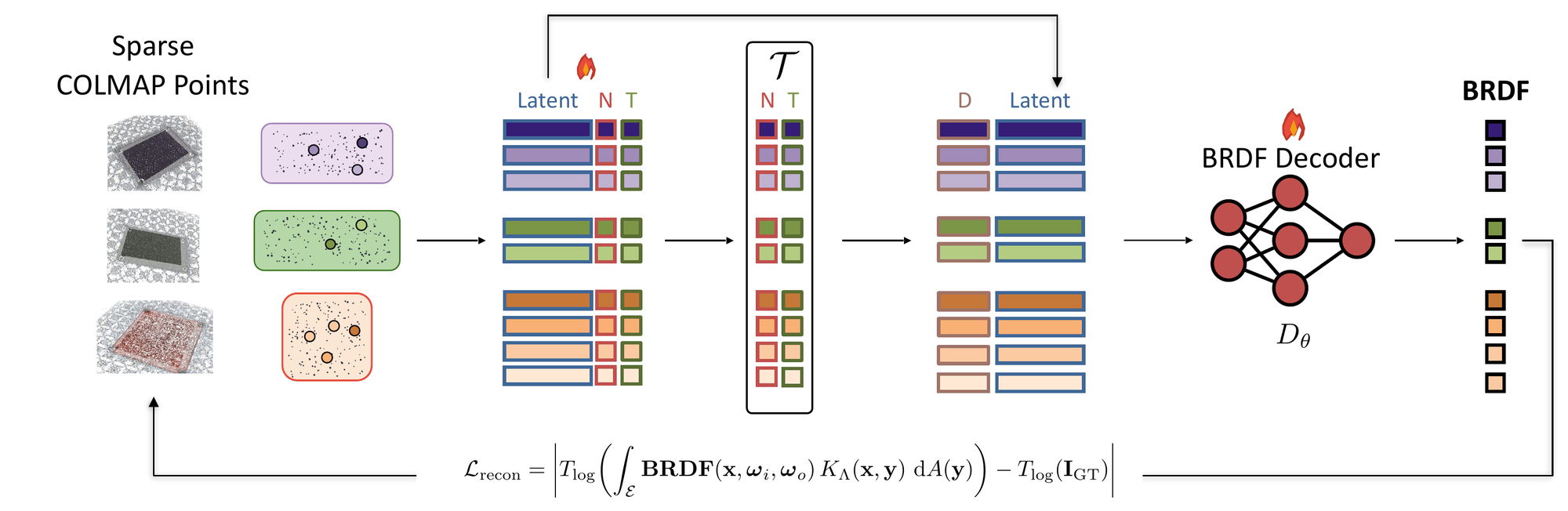
Stage 1 — learning a material prior.
A single BRDF decoder, shared across all training materials, is
optimized jointly (flame icon) with per-point tables of latent codes,
normals, and tangents.
N: normal, T: tangent, D: encoded local directions; each color
denotes one material, with a few points drawn per material in every
minibatch.
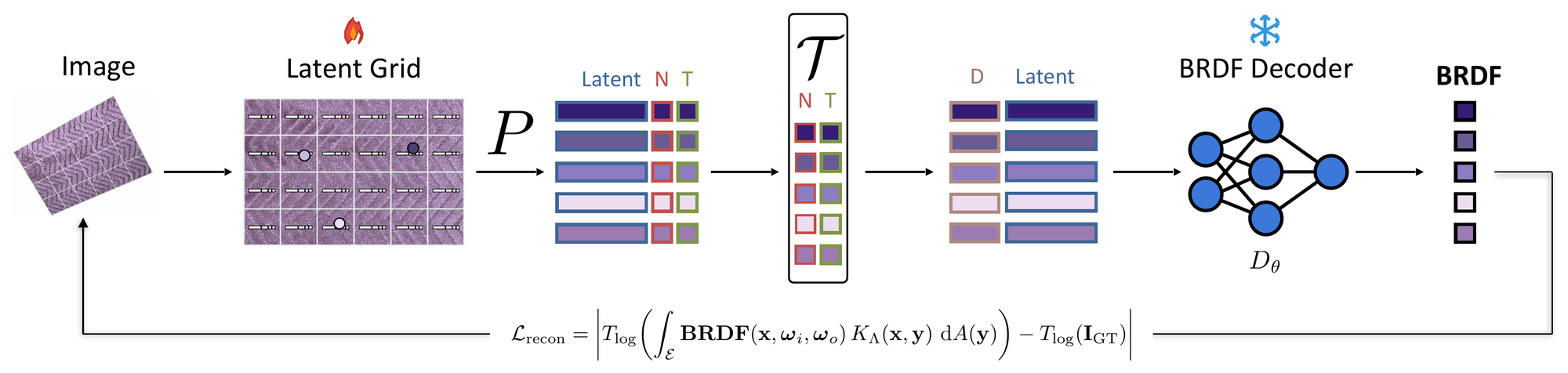
Stage 2 — dense material reconstruction.
For a single target material, a dense latent-geometry texture is
optimized (flame icon) through the parallax-aware lookup P, the
shared transform 𝒯, and the frozen decoder (snowflake icon).
Notation as in Stage 1.
Method
Texture the room with a trained material
Drag a material onto any sofa, pillow, cushion, the rug or the curtain.Tap a material, then any sofa, pillow, cushion, the rug or the curtain.
Loading the room…
Rendering note
Each tile is a trained 2048×2048 latent texture, coloured by decoding every texel
with the frozen decoder under a 45° light. Dropped on an object, it becomes the full
material (relief, sheen and view dependence), which is path-traced on
the piece you choose; every piece takes its own material. Each piece is pre-rendered in
every material (3840 px, 1024 spp; 1920 px on phones and standard screens)
and the combination is assembled live;
the light a dressed piece throws onto the rest of the room is added as a smooth
low-resolution correction.
Dataset Preview
The dataset is split into a train set and a test set
following the official lists in
globals/training_list_500.txt /
globals/test_list_500.txt.
20 train and 5 test materials are shown as thumbnails below;
every one of the remaining materials is linked further down so
you can browse all 400 + 100
without leaving this page.
Train20 of 400 shown
Loading preview manifest…
Test5 of 100 shown
All material IDs — every train and test material, each linked to its viewer
Trainall material IDs
Testall material IDs
Results
Compared with existing material datasets
Dataset
Year
Materials
Cloth-specific
Real-world
Spatially varying
Multiple views
Flexible coverage
MERL main baseline
2003
100
UTIA
2014
150
UBO2014 main baseline
2014
84
UBOFAB19 main baseline
2019
378
Real-SVBRDF
2020
80
PhotoMat
2023
12,000
UMat
2023
2,000
OpenSVBRDF
2023
1,000
MatSynth
2024
4,069
RoboCloth ours
2026
500
Cloth-specific: the materials are fabrics.
Real-world: measured from physical samples, not synthesised.
Spatially varying: reflectance captured per surface point (a texture), not one BRDF per material.
Multiple views: more than two distinct viewing directions.
Flexible coverage: camera and light poses not confined to a fixed dome, gantry or scanner
layout — RoboCloth is the only dataset with all five properties.
Main baseline: UBO2014 is the test benchmark of the chart; MERL and UBOFAB19 train the competing decoders.
Reconstruction quality on UBO2014
A controlled protocol: the decoder architecture, renderer and Stage 2 procedure are held fixed
across all comparisons, so differences in reconstruction quality are directly attributable to the
training data — a decoder trained on RoboCloth, UBOFAB19 or MERL, fitted to
12 held-out UBO2014 materials; PBR is an analytic fit with no learned prior.
Qualitative comparisons
Same protocol as above — the decoder, renderer and Stage 2 fitting are fixed and only the Stage 1
training data changes. Every recovered material is relit in a common scene: the same cloth mesh draped over a
bar, with identical UV tiling, lighting and camera for every method, so any visible difference is due solely to
the learned material. Click a figure to open it at full resolution.
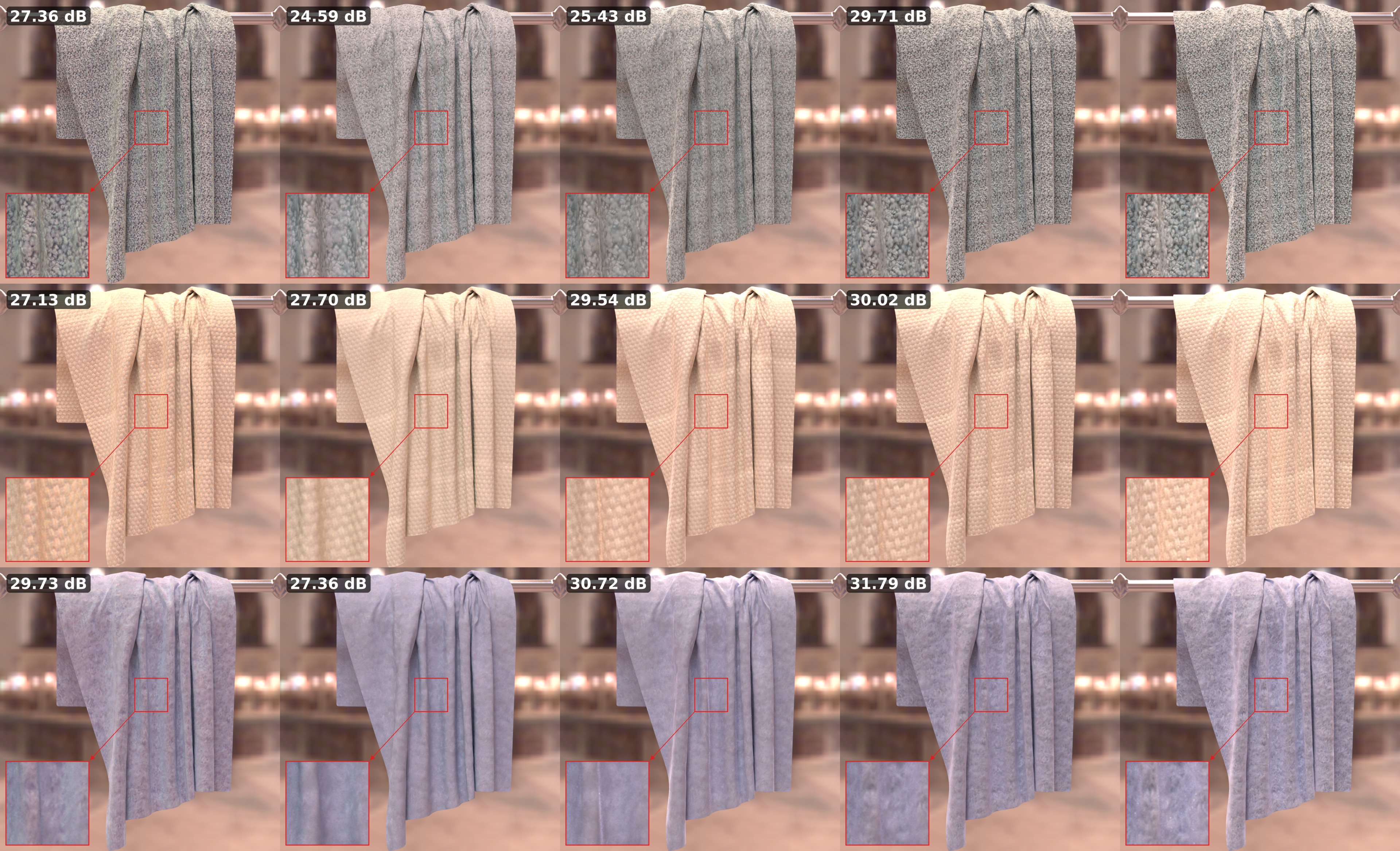
UBO2014 — close-up on three held-out materials
UBOFAB19MERLPBRRoboClothGT
carpet12fabric02felt01
The MERL-trained decoder, trained only on spatially-uniform isotropic BRDFs, loses the weave structure and drifts in colour; the UBOFAB19-trained decoder recovers texture but shifts the overall hue (e.g. fabric02), and the analytic PBR baseline misses the fine sheen. Only the RoboCloth decoder matches the ground-truth colour while preserving both the specular highlight at the fold and the fuzzy weave detail. Each cell insets a magnified crop of the boxed region, taken from the full-resolution render; the number in each cell is the PSNR (dB) of the rendered image against the GT render, highest for RoboCloth in every cell.
Renderingpath traced at 1024×1024 (the carpets and fabric11 at 2048×2048), 512 spp, under an HDR environment map; the GT column is the measured UBO2014 BTF rendered in the same scene.
The full set — all 12 UBO2014 materials, the RoboCloth and UBOFAB19 test sets, and image-space comparisons
against the captured photographs — is on its own page.
@misc{li2026robocloth,
  title  = {RoboCloth: A Large-Scale Real Cloth Material Dataset for Neural Reflectance Reconstruction},
  author = {Li, Zhen and Qin, Haoran and Di Sario, Francesco and Rebain, Daniel and Tagliasacchi, Andrea},
  year   = {2026}
}




 Results